

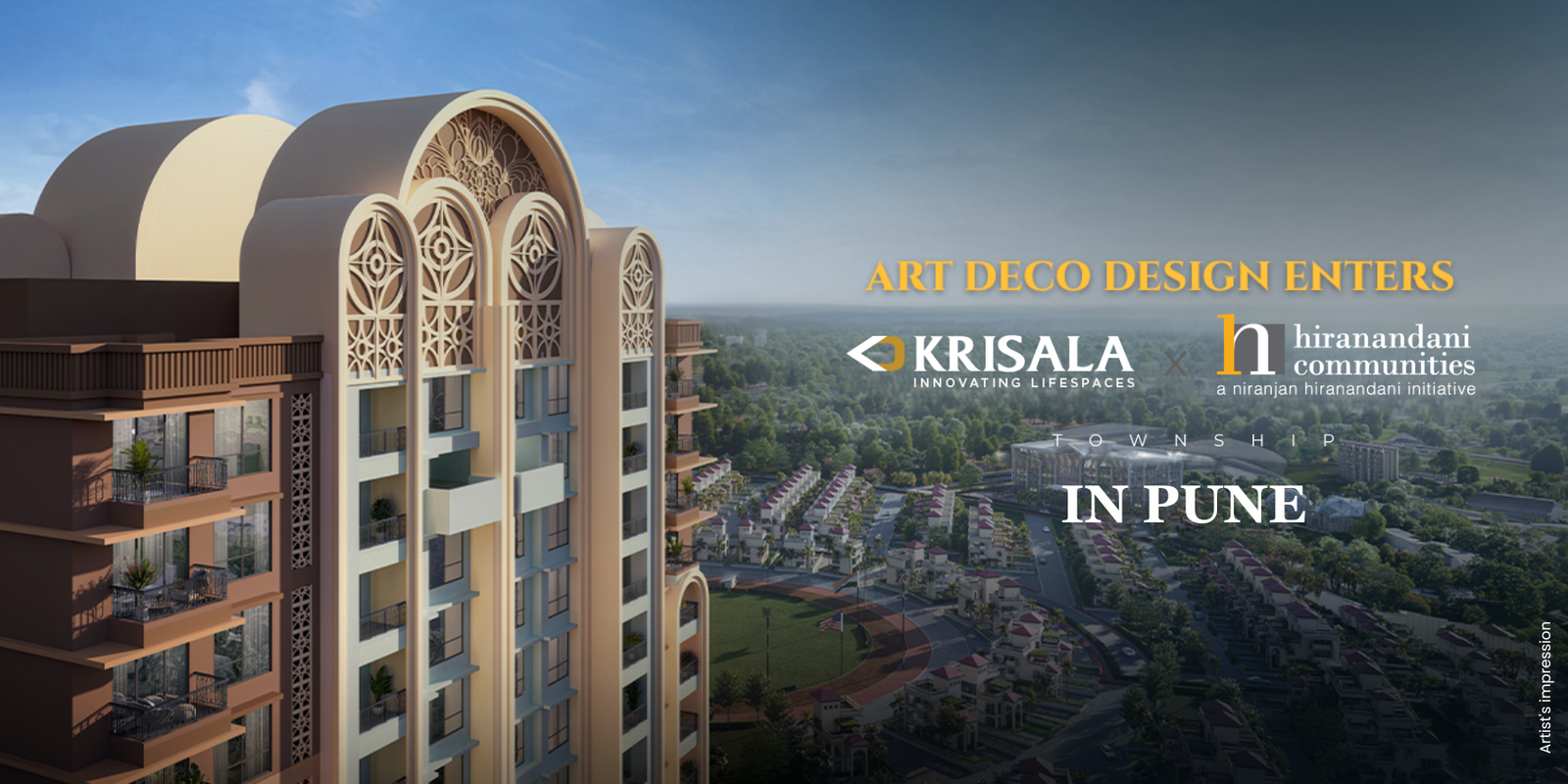
Art Deco Design Enters Krisala x Hiranandani Township in Pune
Walk down Marine Drive in Mumbai at sunset or look up at the Chrysler Building’s stainless-steel crown in New York, and you’ll notice something odd: buildings that are close to a century old still look futuristic. That staying power is the whole story of Art Deco, and it’s also the design language behind ICON, the residential address rising within the Krisala x Hiranandani township in Pune.
Before we get to ICON itself, it’s worth understanding the style that inspired it, where it came from, how to recognise it, and why architects keep returning to it a hundred years later.
Where Art Deco Came From
Art Deco emerged in France in the years just before and after the First World War and announced itself properly at the 1925 Exposition Internationale des Arts Décoratifs et Industriels Modernes in Paris, the exhibition that gave the style its name. It was a deliberate break from the flowing, floral lines of Art Nouveau that came before it. In its place came geometry, symmetry, and a sense of order that felt distinctly modern.
The style borrowed from everywhere:
- Cubism lent it bold, faceted shapes
- Ancient Egyptian motifs, popularised after the discovery of Tutankhamun’s tomb, brought in sunbursts and stepped forms
- Ballet and theatre of the era added colour and drama
- New engineering, reinforced concrete and steel frame construction, let architects build taller and more boldly than ever before
By the 1930s, Art Deco had crossed the Atlantic and reshaped the American skyline, giving the world icons like the Chrysler Building and the Empire State Building.
How to Recognise Art Deco
Art Deco buildings share a visual vocabulary that holds up across a century of imitation and adaptation:
- Strong vertical lines that draw the eye upward, emphasising height and ambition
- Stepped, setback forms, where a building’s silhouette narrows in tiers as it rises
- Geometric ornamentation, chevrons, zigzags, sunbursts, and repeating patterns rather than the curling florals of earlier styles
- Symmetry and proportion, with facades composed around a clear central axis
- A considered material palette, combining stone, metal detailing, and glass to signal permanence and craftsmanship
None of this was ornamentation for its own sake. Every element was meant to express progress, confidence, and modernity at a moment when the world was rebuilding itself after war.
India’s Own Chapter: Bombay Deco
Art Deco didn’t stay a Western phenomenon for long. Bombay, as it was then known, embraced the style with such enthusiasm that it now holds one of the largest collections of Art Deco buildings anywhere in the world. The Backbay Reclamation Scheme of the early twentieth century gave the city Marine Drive’s sweeping, sea-facing row of Art Deco apartments and cinemas, an ensemble so significant that UNESCO inscribed it as a World Heritage Site in 2018, standing directly across the Oval Maidan from the city’s earlier Victorian Gothic buildings.
What makes Bombay’s version distinct is how thoroughly it was localised. Architects didn’t just import the style, they adapted it:
- Balconies and verandas built in for Indian weather, unlike the more closed facades of Western Art Deco
- Motifs from Indian mythology, folded into facade reliefs and ornamentation
- Tropical flora and fauna, replacing the European florals of earlier styles
- Imported geometry and Egyptian-inspired forms, retained alongside these local touches
The result came to be known as Indo-Deco, a hybrid that was, in spirit, unmistakably Indian even as its bones were international.
Why the Style Never Really Left
Trends date quickly. Art Deco hasn’t, and there’s a reason for that.
A few reasons the style has outlasted almost every trend that came after it:
- Its geometry is disciplined, not decorative – it ages the way good tailoring does, rather than the way a fashion print does
- Its verticality still reads as ambitious, whether a building was completed in 1930 or 2026
- It was never tied to one material or motif, so it translates easily into contemporary construction without losing its identity
- It sits confidently between two extremes – never bare minimalism, never excessive ornamentation
That balance is precisely why Art Deco keeps resurfacing in high-end residential design today, offering a way to signal permanence and quality that feels neither dated nor over-designed.
The Inspiration Behind ICON
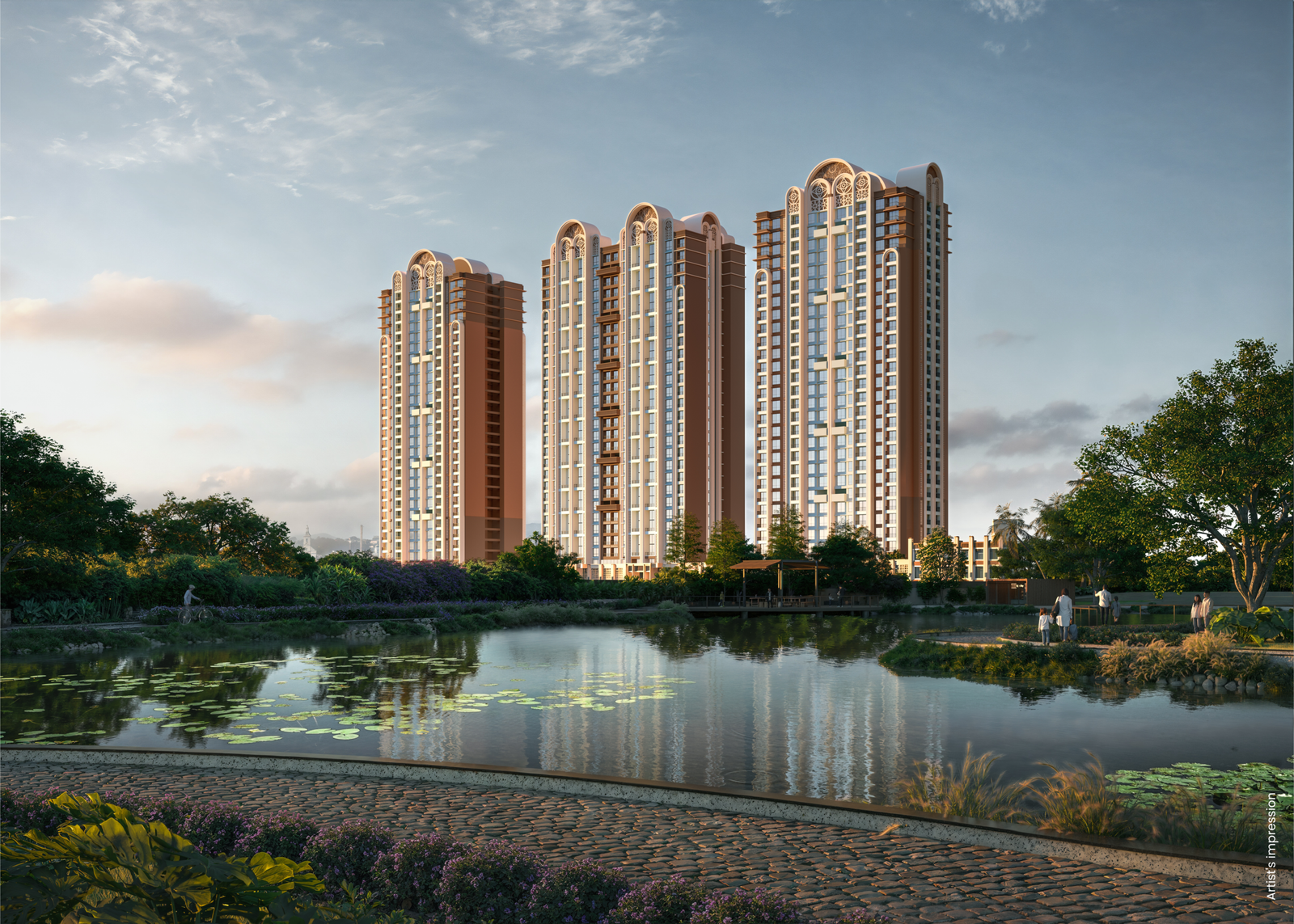
ICON, part of the Krisala x Hiranandani township in Pune, draws its architectural language directly from this tradition.
The development comprises three independent residential towers rising twenty-seven floors above a shared podium. Each tower stands structurally apart, giving every building its own identity, privacy, and uninterrupted views, while all three come together at ground level through a common podium deck and shared amenities. It’s a planning approach that mirrors the Art Deco instinct for individual verticality within an overall composition of balance.
Across the facades, that Art Deco vocabulary is unmistakable: strong vertical proportions, geometric detailing, clearly framed elevations, and a refined material palette that gives the towers a presence that feels both classic and current. Inside, the same sensibility carries through, from the arrival lobby’s clean geometry and layered lighting to the considered proportions of the common spaces.
The 316 residences at ICON, spanning 3 and 4 Bed Residences simplex and duplex configurations, are positioned to make the most of forest-facing views over the township’s landscaped grounds, with layouts designed around cross ventilation and natural light. It’s the same underlying philosophy that made Art Deco buildings desirable a century ago: architecture that isn’t just striking to look at, but genuinely well considered to live in.
A Style Built to Last
From Paris to Manhattan to Marine Drive, and now to a growing township in Pune, Art Deco’s appeal has never really been about trend. It’s about proportion, craftsmanship, and a certain confidence in the vertical line. ICON’s design borrows that century-old language and puts it to work for contemporary living, proof that when a style is built on genuinely sound principles, it never really goes out of style. It just finds its next address.